
Best Trading Discord Servers for Day Traders
It’s a landscape crowded with inactive servers and premium subscriptions that promise unverified results, but reliable communities exist that fit all types of traders.
Overview of Trading Discord Servers
Let us make some introductions to the Discord servers worth your attention, and what makes the best servers a place traders can truly belong.
- The 5 criteria of legitimate trading Discords
- 7 free Discord communities with real value
- The top Discord community for options day traders
Wait, what's Discord?
Discord is a chat app hosting topical community channels with text, voice, and screen sharing. A great place for online trading communities!
What Makes a Great Trading Discord
Before you join any trading Discord, ask yourself: Is this community designed to help me succeed, or to keep me dependent?
Traits of a Trustworthy Trading Discord:
1. Transparency and Passion
Real traders share wins AND losses. If you only see screenshots of massive gains, consider it a warning. Legitimate communities track results honestly and admit when setups fail.
2. Focused Signal Analysis
Great Discords teach you why a trade makes sense, not just what to buy. If you're still learning to interpret setups, start with our Best Indicators for Day Trading guide.
3. Diplomatic Mods
The best mods enforce rules, ban scammers, and empower productive interactions. They don’t belittle beginners or flex their P&L.
4. Community Accountability
Members have each other’s backs. Blame has no place in losses, and transparent trading fosters encouragement and mentorship.
Trading Discord Warning Signs
Some trading Discords are used like car lots, where you’re met by a disguised salesman the moment you enter. Legitimate communities never guarantee profits. They don't pitch "VIP access" within your first hour. Scammers sell products that don’t exist, and promised profits are the favorite bait of trading-fakers.

Top Trading Discords
Every trading community has a different focus, strengths, and limitations. These are places where traders have found quality education or strong communities in the past years.
Trading Discords with Free Access
1. Bear Bull Traders
Best For: Learning day trading fundamentals
Member Count: 10,000+
Focus: This server offers free access to live trading rooms where experienced traders share their screens and explain entries/exits in real time. The free Discord is a preview. Advanced mentorship, proprietary scanners, and full access to live streams—requires a $99+ premium subscription. You'll learn concepts, but you're still trading unassisted.
Trade-off: The free tier is deliberately limited to show you what you're missing and push you toward the $99/month premium.
2. Topstep
Best For: Futures traders and trading psychology
Member Count: 85,000+
Focus: Free Discord with 50+ channels covering futures strategies, risk management, and trader psychology. Free group coaching sessions. For traders interested in prop trading (getting funded to trade with firm capital).
Trade-off: Heavy focus on futures and prop firm preparation. If you're trading stocks or options exclusively, much of the content won't apply to you.
3. r/CryptoCurrency Official Discord
Best For: Crypto traders seeking unbiased discussion
Member Count: 74,000+
Focus: The official Discord for Reddit's largest crypto community (9+ million members). News-focused market analysis with beginner-friendly education.
Trade-off: Crypto-only focus means zero help with traditional markets. Also, sentiment can swing wildly with market conditions—expect FUD and FOMO in equal measure.
4. Stock Market Chat
Best For: General market discussion and collaboration
Member Count: 5,000-10,000
Focus: Free server with live SPY updates every 30 minutes, daily/weekly stock-picking games, and a library of educational resources. Members share chart analysis and trade ideas in a collaborative, low-pressure environment.
Trade-off: Smaller community means less activity outside peak market hours, especially if you trade pre-market or after hours.
5. r/WallStreetBets Official Discord
Best For: Retail sentiment and meme stock culture
Member Count: 485,000+
Focus: The infamous community that sparked the GameStop squeeze. Free, hyper-active during market hours, and useful for gauging retail trader mood. More of a cultural phenomenon than a learning environment.
Trade-off: Signal-to-noise ratio is almost cartoonish. Expect 95% memes and hype, 5% actionable insight. Not a learning environment—it's entertainment with occasional alpha.
Paid Trading Discords
Many day traders like to diversify into other trading strategies. Here are some paid resources that can help traders test out new ways to trade:
1. The Swing Trading Club ($47-97/month)
Best For: Swing traders holding positions for days or weeks
What You Get: Community-driven swing trade alerts, a swing trading course, and a Discord where members share multi-day setups and collaborate on entries/exits.
Trade-off: At $47-97/month, you're paying for alerts and community access, but there's no verified track record published. You're trusting the community's judgment without documented historical performance.
2. Crystal Academy ($65/month, free tier available)
Best For: Traders struggling with psychology and discipline
What You Get: Trading psychology calls, mentorship programs, pre-market analysis, and education on prop firm strategies. The focus is on mindset and emotional control, not just signals.
Trade-off: Psychology-heavy approach means less focus on specific trade setups or technical strategies. If you want signal calls and chart analysis, look elsewhere.
A New Contender in Day Trading Communities
Most trading Discords fall into two camps: signal services that tell you what to buy without teaching you why, or educational communities piling on endless indicators for you to juggle. Jarvis takes a simpler approach: automated signals backed by transparent, real-time education.
What makes Jarvis different:
- Built around proprietary signal software that presents simple [LONG_TAG] and [SHORT_TAG] tags
- Daily JarvisLIVE sessions where expert mods trade in real-time with full transparency
- Designed for intermediate traders who want to simplify, not add more complexit
Jarvis Discord Status: Founding memberships are available now with a 30-day free trial.
Why we're including it here: The gap for simplified options trading is real. If you’re an intermediate trader who feels stuck and overwhelmed, this is for you.
There are some incredible trading communities out there–truly something for everybody! If you want to be part of building something specifically designed to simplify your day trading experience, [join the Jarvis founding members].
Questions Traders Ask Most About Trading Discords
Before joining a trading Discord, it's smart to know what you're getting into. These are the questions traders ask most - from spotting legit communities to comparing free vs. paid servers, and how Jarvis fits into it all.
Unlike most Discords that rely on manual alerts or unverified calls, Jarvis combines automated signal software with live, transparent trading education. Members see trades unfold in real time, learn the reasoning behind entries and exits, and can join a 30-day free trial as founding members before launch.
Paid trading Discords can be valuable if they provide mentorship, structured education, or verified track records — not just alerts. Servers like The Swing Trading Club and Crystal Academy offer advanced resources for traders seeking deeper insights, but free communities often provide enough for beginners to grow first.
A legitimate trading Discord emphasizes transparency, verified results, and community learning over hype or guaranteed profits. Look for active moderation, educational discussions that explain why a trade works, and a culture where both wins and losses are shared honestly.
Some of the best free trading Discord servers include Bear Bull Traders, Topstep, r/CryptoCurrency Official, Stock Market Chat, and r/WallStreetBets.
Each focuses on different aspects, from technical setups to market sentiment - and offers education or community discussion without a paid barrier to entry.
Explore More
Smart traders make great decisions using Jarvis. Here are some resources to guide you along your trading journey.

What are trading signals
Have you ever wondered if buy and sell signals in trading offer any real value for your strategy?
A trading signal is an algorithmic or AI-driven indicator that tells you exactly where the high-probability setups are on a chart. For traders whose strategy has been reliant on guesswork or left them drowning in data, signals allow trading with greater confidence in data-backed decisions.
Many traders start out expecting to will their way to success, but the marketplace is a treacherous space when armed with nothing but intuition. Signal trading tools can deliver an edge in a market where retail traders compete against high-powered market makers using sophisticated resources of their own. Here are trading signals explained for today's tech-driven trading landscape.
What is a trading algo?
An algo (algorithm) is a set of rules a computer follows to make a decision. Some algos are built to fully automate trading, from insight to execution. For algos that leave buying and selling in the hands of retail traders, a tool will surface entry signals on a live trading chart, highlighting high-probability trading setups.
The difference between signals and indicators
Think of a trading signal as a type of indicator that conveys a higher expression of intent.
If an indicator effectively distills data into a new visual distinction, like a line or a range on your trading chart,it's still entirely up to the user to interpret that data. Indicators give traders raw material to build from. That's valuable for traders who like to craft elaborate strategies, but rebuilding an underperforming strategy costs time that could be spent in the market.
This is where signals take data interpretation a step further, turning it into actionable insights. A signal is not necessarily telling a trader "you must trade right now," but it is surfacing the precise moment to make a decision based on verified data.
Algo vs AI trading: Which is better?
LLMs like ChatGPT and Claude are fundamentally algorithmic, making it difficult to distinguish between algo/AItrading. Both modes perform heavy data-lifting to simplify and speed up decision-making for traders.
The core differentiator is this: algorithms predefine exact thresholds for decision points, where as AI logic can be reinterpreted up until the moment of decision. There are advantages and drawbacks for each design.
Algo trading models process formulas instantly and interpret them using fixed rules, so systems know exactly which event will occur when certain metric thresholds are met.
- Algo upside: predictable parameters & repeatability
- Algo downside: less dynamic agility
AI trading models will actively review the logic at every stage, dynamically resetting parameters.
- AI upside: constant refresh of information
- AI downside: unverifiable, sometimes hallucinogenic logic
Signals make trading simpler
Trading has a reputation for complexity, but more screens and data matrices may not be the edge that tradersthink they are. 97% + of day traders aren't profitable, and it's likely that the elaborate strategies and modelstraders have sought to liberate them have actually made it harder to win.
In signal-centric strategies, computation happens under the hood. Each signal represents thousands of datapoints, indicating an entry opportunity. You don't have to comprehend the complexity. Instead, you get to acton the insights of the data.
The true challenge of simplicity
How do traders misuse trading signals? By overriding the data. Second-guessing confirmed entries while theseconds tick by. Chasing a signal after sitting down at your laptop three minutes too late. There are a hundredways to get it wrong. The good news is that the pattern is recognizable, and so is the way out.
Trading simplified is not trading made easy. Trading with signals is a great start to mitigate emotional trading, but universal truths still apply:
- Risk is inherent to trading: every profitable strategy comes by surviving losses and earning your way to consistency.
- Half the battle is in your mind: no algorithm can out-discipline an impatient trader who refuses to learn.
- Results are your responsibility: the market is uncaring, so make every loss a lesson, not a reason toblame.
For traders who are committed to self-discipline from day one, all that’s needed is a system on which to build a longstanding strategy.
How Jarvis helps traders
Jarvis is a sophisticated trading tool that automates the signal, not the execution. Here is what this looks like inpractice.
- Solving the complexity problem : When we were designing Jarvis, our daily question was "How can we make this even simpler?" LONG & SHORT signals are as simple as green light / red light, and by toggling timeframes, you can set these uniquely for the same symbol to fit day trading, swing trading, or investing.
- Knowing when not to trade : The most important rule in trading is this: Don’t lose money. This isn’t about finding great trades; it’s about avoiding bad ones. Every moment between Jarvis signals is a moment traders can sit out high-risk trades. Ifthere's no signal, there's no action required.
- Entry signals & exit indicators : Every signal indicates high-probability entry opportunities based on real data. These are not 100% guarantees of winning setups (no such service exists), but the logic behind them is built on a strong foundation of livemarket analysis and past price action, giving traders something real to believe in and build their strategy on.Similarly, the trailing Cloud indicator helps track exit opportunities for active positions so you can protect profitsand avoid overstaying.
Simplified trading is still trading
Signal trading is not a shortcut around the work. Algo signals change cognitive load, but they don't remove risk or responsibility. At the end of the day, all that matters is taking the right trade at the right moment, andknowing when to walk away.
Jarvis helps traders **keep emotion out of the equation** and make clearer, more decisive trades by trusting in a tool built on decades of trading experience. If you’re a trader who is committed to finding a strategy that willlast, start by putting some power behind it.
FAQ
What is a trading signal and how does it work?
A trading signal is a visual cue generated by an algorithm that highlights a high-probability entry point on a trading chart. When predefined market conditions are met, such as volume thresholds, price action, ormomentum data, the algo surfaces a LONG or SHORT tag. The trader then decides what action to take.
Are trading signals reliable?
No signal is 100% predictive, and any platform claiming otherwise should raise a flag. What reliable signals offeris data-based probability, a structured edge over emotionally-driven decisions. Signals are meant to improve consistency, not guarantee results.
What's the difference between a trading signal and an indicator?
An indicator provides data for interpretation. A signal interprets it for you, making it faster and less dependent on a trader's ability to read and respond to raw data in real time.
Can beginners use trading signals?
Yes, and in many ways, signals lower the barrier to entry. Rather than spending years developing the intuition to read charts and build day trading strategies from scratch, a beginner with a signal-based tool can learn torecognize and act on high-probability setups much faster.
Do professional traders use signals?
Many do, though the terminology varies. Institutional traders operate within highly structured rule sets,automated triggers, and defined entry criteria, which is functionally what a signal delivers. What separates professional from amateur trading is not the absence of tools, but the discipline to use them without overriding them.
Have you ever wondered if buy and sell signals in trading offer any real value for your strategy?
A trading signal is an algorithmic or AI-driven indicator that tells you exactly where the high-probability setups are on a chart. For traders whose strategy has been reliant on guesswork or left them drowning in data, signals allow trading with greater confidence in data-backed decisions.
Many traders start out expecting to will their way to success, but the marketplace is a treacherous space when armed with nothing but intuition. Signal trading tools can deliver an edge in a market where retail traders compete against high-powered market makers using sophisticated resources of their own. Here are trading signals explained for today's tech-driven trading landscape.
What is a trading algo?
An algo (algorithm) is a set of rules a computer follows to make a decision. Some algos are built to fully automate trading, from insight to execution. For algos that leave buying and selling in the hands of retail traders, a tool will surface entry signals on a live trading chart, highlighting high-probability trading setups.
The difference between signals and indicators
Think of a trading signal as a type of indicator that conveys a higher expression of intent.
If an indicator effectively distills data into a new visual distinction, like a line or a range on your trading chart,it's still entirely up to the user to interpret that data. Indicators give traders raw material to build from. That's valuable for traders who like to craft elaborate strategies, but rebuilding an underperforming strategy costs time that could be spent in the market.
This is where signals take data interpretation a step further, turning it into actionable insights. A signal is not necessarily telling a trader "you must trade right now," but it is surfacing the precise moment to make a decision based on verified data.
Algo vs AI trading: Which is better?
LLMs like ChatGPT and Claude are fundamentally algorithmic, making it difficult to distinguish between algo/AItrading. Both modes perform heavy data-lifting to simplify and speed up decision-making for traders.
The core differentiator is this: algorithms predefine exact thresholds for decision points, where as AI logic can be reinterpreted up until the moment of decision. There are advantages and drawbacks for each design.
Algo trading models process formulas instantly and interpret them using fixed rules, so systems know exactly which event will occur when certain metric thresholds are met.
- Algo upside: predictable parameters & repeatability
- Algo downside: less dynamic agility
AI trading models will actively review the logic at every stage, dynamically resetting parameters.
- AI upside: constant refresh of information
- AI downside: unverifiable, sometimes hallucinogenic logic
Signals make trading simpler
Trading has a reputation for complexity, but more screens and data matrices may not be the edge that tradersthink they are. 97% + of day traders aren't profitable, and it's likely that the elaborate strategies and modelstraders have sought to liberate them have actually made it harder to win.
In signal-centric strategies, computation happens under the hood. Each signal represents thousands of datapoints, indicating an entry opportunity. You don't have to comprehend the complexity. Instead, you get to acton the insights of the data.
The true challenge of simplicity
How do traders misuse trading signals? By overriding the data. Second-guessing confirmed entries while theseconds tick by. Chasing a signal after sitting down at your laptop three minutes too late. There are a hundredways to get it wrong. The good news is that the pattern is recognizable, and so is the way out.
Trading simplified is not trading made easy. Trading with signals is a great start to mitigate emotional trading, but universal truths still apply:
- Risk is inherent to trading: every profitable strategy comes by surviving losses and earning your way to consistency.
- Half the battle is in your mind: no algorithm can out-discipline an impatient trader who refuses to learn.
- Results are your responsibility: the market is uncaring, so make every loss a lesson, not a reason toblame.
For traders who are committed to self-discipline from day one, all that’s needed is a system on which to build a longstanding strategy.
How Jarvis helps traders
Jarvis is a sophisticated trading tool that automates the signal, not the execution. Here is what this looks like inpractice.
- Solving the complexity problem : When we were designing Jarvis, our daily question was "How can we make this even simpler?" LONG & SHORT signals are as simple as green light / red light, and by toggling timeframes, you can set these uniquely for the same symbol to fit day trading, swing trading, or investing.
- Knowing when not to trade : The most important rule in trading is this: Don’t lose money. This isn’t about finding great trades; it’s about avoiding bad ones. Every moment between Jarvis signals is a moment traders can sit out high-risk trades. Ifthere's no signal, there's no action required.
- Entry signals & exit indicators : Every signal indicates high-probability entry opportunities based on real data. These are not 100% guarantees of winning setups (no such service exists), but the logic behind them is built on a strong foundation of livemarket analysis and past price action, giving traders something real to believe in and build their strategy on.Similarly, the trailing Cloud indicator helps track exit opportunities for active positions so you can protect profitsand avoid overstaying.
Simplified trading is still trading
Signal trading is not a shortcut around the work. Algo signals change cognitive load, but they don't remove risk or responsibility. At the end of the day, all that matters is taking the right trade at the right moment, andknowing when to walk away.
Jarvis helps traders **keep emotion out of the equation** and make clearer, more decisive trades by trusting in a tool built on decades of trading experience. If you’re a trader who is committed to finding a strategy that willlast, start by putting some power behind it.
FAQ
What is a trading signal and how does it work?
A trading signal is a visual cue generated by an algorithm that highlights a high-probability entry point on a trading chart. When predefined market conditions are met, such as volume thresholds, price action, ormomentum data, the algo surfaces a LONG or SHORT tag. The trader then decides what action to take.
Are trading signals reliable?
No signal is 100% predictive, and any platform claiming otherwise should raise a flag. What reliable signals offeris data-based probability, a structured edge over emotionally-driven decisions. Signals are meant to improve consistency, not guarantee results.
What's the difference between a trading signal and an indicator?
An indicator provides data for interpretation. A signal interprets it for you, making it faster and less dependent on a trader's ability to read and respond to raw data in real time.
Can beginners use trading signals?
Yes, and in many ways, signals lower the barrier to entry. Rather than spending years developing the intuition to read charts and build day trading strategies from scratch, a beginner with a signal-based tool can learn torecognize and act on high-probability setups much faster.
Do professional traders use signals?
Many do, though the terminology varies. Institutional traders operate within highly structured rule sets,automated triggers, and defined entry criteria, which is functionally what a signal delivers. What separates professional from amateur trading is not the absence of tools, but the discipline to use them without overriding them.

Trading Trending Signals: April 2026 Jarvis Scorecard
April was an incredible month for a rebounding market, but traders are filling up social mediawith their feelings about the tweet turbulence emanating from the executive branch.
Unpredictable X announcements about oil transport or international peace talks are not what Jarvis was built to predict. But the resulting rebound in this month’s market gave way to someSPY signals that showcase the exact intent of Jarvis signals.
Not every Jarvis user trades options, but this month they showcased the force-multiplying powerof signals riding a strong positive market trend.
Note for non-options traders: With options, stock price (~$675) will correspond with anoptions contract price (~$1.10). The prior appears on the Jarvis chart visuals. The latter isincluded in our journal entries, and can be verified with retroactive On-Demand charts in appslike ThinkorSwim.
Trade examples are hypothetical and applied retroactively to demonstrate the Jarvis strategy. Trades were not executed in a live account. Results do not account for liquidity, slippage, or fees.
TRADE 1
Day Trade Options | Timeframe: 1M SPY Call | Apr 2 | 9:47 am – 10:50 amC676 $1.10 → $5.32 | 383% profit

April has been all about identifying trends and trading with them. A LONG tag on a 15Mtimeframe is a good starting place to say that you have a bullish trend. Then, when a 1M LONGtag just above VWAP supports it, like here, it’s the kind of alignment we look for on trend + tag agreement.
This trade matured steadily but really finished with a flourish that locked in a lot of profit forentries at the LONG tag. The SHORT tag preceding it presented some interest and would havelost money. But again, the daily trend was positive, so the trade we were really looking for, we got.
TRADE 2
Day Trade Options | Timeframe: 1M SPY Call | April 9 | 10:56 am – 12:23 pmC650 $0.74 → $4.17 | 463% profit
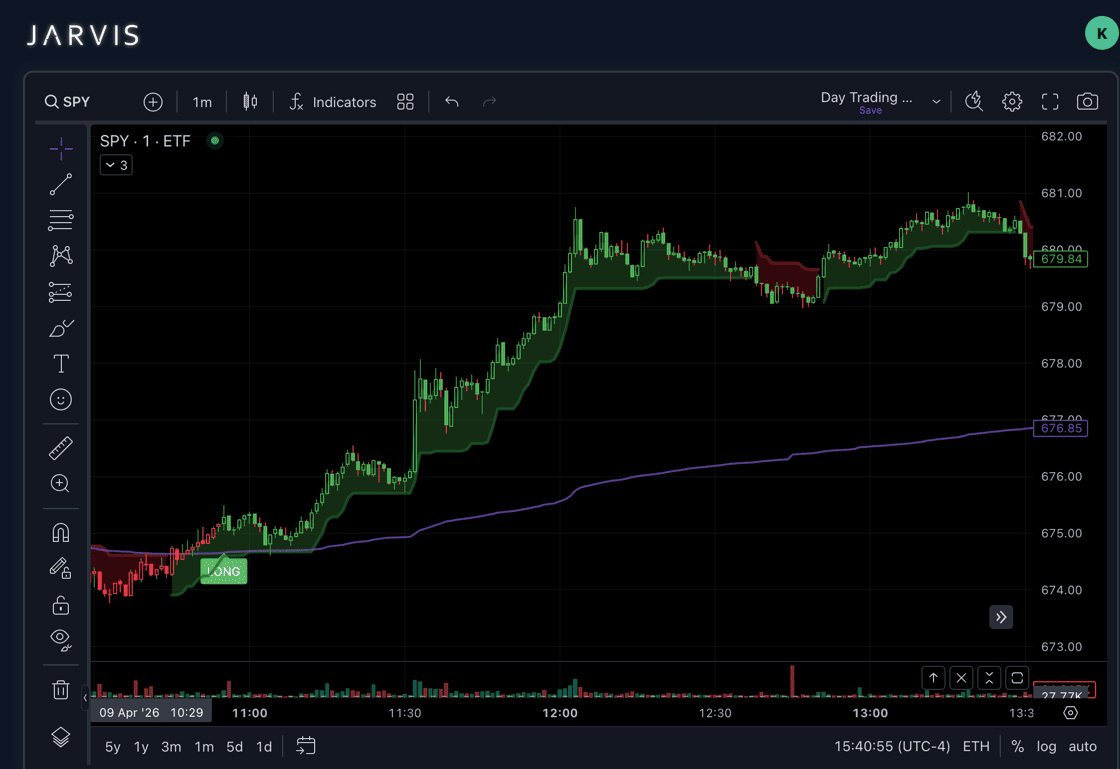
While this looks easy in hindsight, the bottom wicks tested our resolve three times before the11:32 breakout. We rely on the Jarvis cloud to keep things simple, but staying in through bottom tests still requires discipline.
Usually, we look for a cloud break to exit a trade, but with options you also fight decay (more onthat in our next trade). When an extremely profitable position starts to stall, notice the greencloud flattens twice before our 12:23 exit, we don’t like to wait around and give away more profit.We exit this one mid-stall. Huge signal success.
TRADE 3
Day Trade Options | Timeframe: 1M SPY Call | April 24 | 10:40 am – 12:08 pmC712 $0.71 → $1.96 | 176% profit
When day trading options, time decay erodes gains. A stock price gaining modest value may accompany an options instrument that loses value. Just before the huge extension candle, this trade would only have us up only 30% in over an hour. Not optimal for the risk we carry on asame-day expiration instrument.
Once we get a candle that launches our position past 150% profit in a minute, we’re asking how much of it we want to protect. We don’t mind traders exiting even as soon as that candle closes (that would be +200%). But we take the Jarvis cloud break as our standard exit, and we’re content.
Trusting a strategy and winning because of it is the victory that matters most.
The Lesson: The Trend Is Your Friend
Wealth Through Diversification
Being bearish when the market is at an all-time-high is a common fear for traders speculating in territory the market has never tested before. But look at the history on an ETF like SPY. Breaking new highs is what the market, in the long term view, has always done.
The most valuable information you can have, then, is knowledge of the market trend. Our stream this month focused on how Jarvis can showcase trend + signal agreement for even higher-conviction trades.
You saw a few of them here, and we invite you to see the next ones with us live on our daily stream. All free trial members have access. Sign up below, we’d love to see you there.
It's a great day to trade.
[Log in]
Risk Disclosure: Trading stocks, options, futures, and cryptocurrencies involves substantial risk and is notsuitable for every investor. An investor could potentially lose all or more than the initial investment. Risk capital is money that can be lost without jeopardizing one’s financial security or lifestyle. Only risk capital should be used for trading. Past performance is not necessarily indicative of future results.
CFTC Rules 4.41: Simulated performance results have inherent limitations. Unlike an actual performance record,simulated results do not represent actual trading. Since trades have not been executed, results may have under- or over-compensated for the impact of certain market factors, such as a lack of liquidity. Simulated trading programs are generally designed with the benefit of hindsight. No representation is being made that any account will or is likely to achieve profits or losses similar to those shown.
Disclaimer: The information and trading signals provided by KTS Trading, LLC are for educational and informational purposes only and do not constitute investment advice or an offer or solicitation to buy or sell any security. We do not execute trades, manage accounts, or guarantee results. All trading decisions are made solely by you at your own risk. You should consult with a licensed financial advisor before making any investment decisions. KTS Trading, LLC is registered with the U.S. Securities and Exchange Commission.
April was an incredible month for a rebounding market, but traders are filling up social mediawith their feelings about the tweet turbulence emanating from the executive branch.
Unpredictable X announcements about oil transport or international peace talks are not what Jarvis was built to predict. But the resulting rebound in this month’s market gave way to someSPY signals that showcase the exact intent of Jarvis signals.
Not every Jarvis user trades options, but this month they showcased the force-multiplying powerof signals riding a strong positive market trend.
Note for non-options traders: With options, stock price (~$675) will correspond with anoptions contract price (~$1.10). The prior appears on the Jarvis chart visuals. The latter isincluded in our journal entries, and can be verified with retroactive On-Demand charts in appslike ThinkorSwim.
Trade examples are hypothetical and applied retroactively to demonstrate the Jarvis strategy. Trades were not executed in a live account. Results do not account for liquidity, slippage, or fees.
TRADE 1
Day Trade Options | Timeframe: 1M SPY Call | Apr 2 | 9:47 am – 10:50 amC676 $1.10 → $5.32 | 383% profit
April has been all about identifying trends and trading with them. A LONG tag on a 15Mtimeframe is a good starting place to say that you have a bullish trend. Then, when a 1M LONGtag just above VWAP supports it, like here, it’s the kind of alignment we look for on trend + tag agreement.
This trade matured steadily but really finished with a flourish that locked in a lot of profit forentries at the LONG tag. The SHORT tag preceding it presented some interest and would havelost money. But again, the daily trend was positive, so the trade we were really looking for, we got.
TRADE 2
Day Trade Options | Timeframe: 1M SPY Call | April 9 | 10:56 am – 12:23 pmC650 $0.74 → $4.17 | 463% profit
While this looks easy in hindsight, the bottom wicks tested our resolve three times before the11:32 breakout. We rely on the Jarvis cloud to keep things simple, but staying in through bottom tests still requires discipline.
Usually, we look for a cloud break to exit a trade, but with options you also fight decay (more onthat in our next trade). When an extremely profitable position starts to stall, notice the greencloud flattens twice before our 12:23 exit, we don’t like to wait around and give away more profit.We exit this one mid-stall. Huge signal success.
TRADE 3
Day Trade Options | Timeframe: 1M SPY Call | April 24 | 10:40 am – 12:08 pmC712 $0.71 → $1.96 | 176% profit
When day trading options, time decay erodes gains. A stock price gaining modest value may accompany an options instrument that loses value. Just before the huge extension candle, this trade would only have us up only 30% in over an hour. Not optimal for the risk we carry on asame-day expiration instrument.
Once we get a candle that launches our position past 150% profit in a minute, we’re asking how much of it we want to protect. We don’t mind traders exiting even as soon as that candle closes (that would be +200%). But we take the Jarvis cloud break as our standard exit, and we’re content.
Trusting a strategy and winning because of it is the victory that matters most.
The Lesson: The Trend Is Your Friend
Wealth Through Diversification
Being bearish when the market is at an all-time-high is a common fear for traders speculating in territory the market has never tested before. But look at the history on an ETF like SPY. Breaking new highs is what the market, in the long term view, has always done.
The most valuable information you can have, then, is knowledge of the market trend. Our stream this month focused on how Jarvis can showcase trend + signal agreement for even higher-conviction trades.
You saw a few of them here, and we invite you to see the next ones with us live on our daily stream. All free trial members have access. Sign up below, we’d love to see you there.
It's a great day to trade.
[Log in]
Risk Disclosure: Trading stocks, options, futures, and cryptocurrencies involves substantial risk and is notsuitable for every investor. An investor could potentially lose all or more than the initial investment. Risk capital is money that can be lost without jeopardizing one’s financial security or lifestyle. Only risk capital should be used for trading. Past performance is not necessarily indicative of future results.
CFTC Rules 4.41: Simulated performance results have inherent limitations. Unlike an actual performance record,simulated results do not represent actual trading. Since trades have not been executed, results may have under- or over-compensated for the impact of certain market factors, such as a lack of liquidity. Simulated trading programs are generally designed with the benefit of hindsight. No representation is being made that any account will or is likely to achieve profits or losses similar to those shown.
Disclaimer: The information and trading signals provided by KTS Trading, LLC are for educational and informational purposes only and do not constitute investment advice or an offer or solicitation to buy or sell any security. We do not execute trades, manage accounts, or guarantee results. All trading decisions are made solely by you at your own risk. You should consult with a licensed financial advisor before making any investment decisions. KTS Trading, LLC is registered with the U.S. Securities and Exchange Commission.

How to Stop Revenge Trading (Before It Stops You)
After a loss, the next trade is usually the one that gets people in trouble.
You start the day with a plan. You mark your high and low, wait for the setup, and take the trade. Then it goes wrong. Sharp reversal. Stop hit. You're down money and the market doesn't care.
What happens next is where most traders lose more than that first trade ever cost them.
What Revenge Trading Looks Like
Most traders think revenge trading looks like panic. It doesn't. It shows up as false confidence.
The next setup suddenly feels obvious. You're certain about it. But here's what's actually happening:
- You jump back into the same ticker that just cost you money
- You increase your position size, telling yourself you'll recover it in one trade
- You skip your usual checks because they feel unnecessary in the moment
- You call it conviction, but it isn't
That's revenge trading. And from the outside, it's easy to spot: faster entries than usual, ignoring your own rules, increasing your size to win back losses, and focusing on the ticker that hurt you instead of paying attention to the market.
Loss aversion makes traders feel losses twice as strongly as gains. As soon as a trade goes wrong, your brain is under emotional pressure it didn’t have before. The market stays the same, but your mindset shifts.
That's the psychology before the next trade even loads. Self-doubt sets in. Second-guessing replaces process. At that point, the market hasn't changed, but the trader has. That's when accounts start to bleed.
You'll Never Willpower Your Way Out
Traders set rules. They promise themselves it won't happen again. After the next loss, it often does.
Willpower runs out. Research in trading psychology shows that emotions like fear and greed don’t just influence decisions—they can take over. After a loss, your brain goes into recovery mode.
No amount of willpower or discipline can fix that in the moment.
A veteran trader in the Jarvis Discord — with over twenty years in the market — made an emotional entry last year. He broke his own rules. Caught himself mid-trade and got out.
When the community called it out, he agreed: it was a bad entry, and he knew it before he ever took it. The trade could have cost him $10,000 to $15,000.
Twenty years of experience. He still did it.
Knowing the rules and following them under pressure are two different things. Structure is what closes that gap. Not the willingness to do better, but a system that makes the decision before emotion gets involved.
Knowing what to do and actually doing it under pressure are two different things.
Most traders are in a stage where overconfidence and awareness haven't caught up to each other yet.
The gap isn't motivation. Traders at this stage have already proven they can make money.
What they haven't built is the structure that holds when emotion takes over.
That's what's missing.
How Jarvis Breaks the Cycle
On a Friday morning, by 9:50 AM, every trader in the session had made between 67% and 254% on a single trade. Discord shut down for the day. Go home. See you Monday.
Big win. Day's over. The day is done. The quickest way to lose a great morning is to keep trading after a win.
What willpower can't is remove the decisions that emotion corrupts. Not by managing how a trader feels, but by making the entry criteria objective.
Objectives don’t care about your feelings. FOMO lives in the gap between "I see a setup" and "I checked the criteria." Jarvis closes that gap.
Here are the three rules that put a stop to revenge trading:
Rule 1: The tag.
No Jarvis signal on the 1-minute chart, no trade. Full stop. A gut feeling isn't a tag. The need to recover isn't a tag. The signal fires or it doesn't. Nothing else qualifies as an entry.
Rule 2: The range.
Even if you get a tag, if the price isn’t within your set range, you don’t take the trade. This rule stops you from chasing.
If you want to jump in outside your range, the answer is always the same: you can’t take that trade. You’ll get hurt if you do. No exceptions.
Rule 3: The 1 Gate 3:
The 15-minute trend. This chart tells you which direction to trade. If everything is red, you only take puts. Don’t rely on your feelings—the 15-minute chart gives you the answer. Your job is to follow it.
Learn the Jarvis community names directly: riding bareback. That's when a loss hits on a tag and the next trade gets entered before the signal forms, driven by the need to get the money back.
This is revenge trading in its purest form. The only person getting revenge is the market.
Wait for the next tag. Every time. No exceptions.
Before every trade, ask yourself: Are you angry? Are you trying to get even? If yes, turn off your computer and come back tomorrow. The market will always offer another setup. Your job is to be ready when it does.
The Reset: No Signal, No Trade
One of the most experienced traders in the Jarvis community made 16 trades from January to April and only had one loss. It wasn’t because he never felt tempted to break the rules. It’s because the criteria don’t care about feelings—they either say yes or no.
Here's what trading with a signal-based system does: a loss doesn't change the rules. The trend, the range, and the tag are still required. All three, every time. Being down money is not a fourth input. It carries no weight in the equation.
The traders who stop revenge trading aren’t the ones who became tougher. They’re the ones who removed the option altogether.
No signal, no trade. That's not a mindset exercise. That's a rule. And it's the only rule that holds when everything else stops working.
Try a free 30-day trial and experience what it’s like to trade with structure.
The information provided is for educational purposes only and does not constitute financial or investment advice. All trading involves risk. Past performance is not indicative of future results.
Frequently Asked Questions
Q: What is revenge trading and why do traders do it?
Revenge trading happens when you stop trading because of a good setup and start trading just to win back money, get even with a ticker, or prove your last loss was a mistake.
It’s an emotional reaction after a loss, often marked by rushing, taking bigger positions, breaking your own rules, and focusing on recovery instead of your edge.
Traders do this because loss aversion is built into our brains—losses feel twice as painful as gains feel good. That imbalance puts pressure on your decisions as soon as a trade goes wrong. What seems like new confidence is really just panic in disguise.
Q: How do I stop revenge trading in real time?
Before your next trade, ask yourself two things: Are you angry? Are you just trying to get your money back? If you answer yes to either, close your screen and come back tomorrow. The market will always offer another setup, and your job is to be ready for it.
To stop revenge trading in real time, use criteria that emotions can’t override: a set range, a confirmed signal, and a trend that matches your direction. If any of these are missing, don’t trade—not because you’re being disciplined, but because your rules say no.
Q: How does Jarvis help prevent revenge trading?
Jarvis takes away the decisions that emotions can mess up by making entry criteria objective. For a valid trade, three things must happen: the 15-minute trend confirms the direction, the price is within the set range, and a Jarvis tag appears on the 1-minute chart.
If any of these are missing, you don’t trade. Losses, frustration, and the urge to recover don’t matter in this system. The signal either appears or it doesn’t. Jarvis also makes it clear when you’re riding bareback—jumping in before the next tag is a sure sign of revenge trading.
The system sticks to the rule, even if you don’t want to. No signal, no trade.
After a loss, the next trade is usually the one that gets people in trouble.
You start the day with a plan. You mark your high and low, wait for the setup, and take the trade. Then it goes wrong. Sharp reversal. Stop hit. You're down money and the market doesn't care.
What happens next is where most traders lose more than that first trade ever cost them.
What Revenge Trading Looks Like
Most traders think revenge trading looks like panic. It doesn't. It shows up as false confidence.
The next setup suddenly feels obvious. You're certain about it. But here's what's actually happening:
- You jump back into the same ticker that just cost you money
- You increase your position size, telling yourself you'll recover it in one trade
- You skip your usual checks because they feel unnecessary in the moment
- You call it conviction, but it isn't
That's revenge trading. And from the outside, it's easy to spot: faster entries than usual, ignoring your own rules, increasing your size to win back losses, and focusing on the ticker that hurt you instead of paying attention to the market.
Loss aversion makes traders feel losses twice as strongly as gains. As soon as a trade goes wrong, your brain is under emotional pressure it didn’t have before. The market stays the same, but your mindset shifts.
That's the psychology before the next trade even loads. Self-doubt sets in. Second-guessing replaces process. At that point, the market hasn't changed, but the trader has. That's when accounts start to bleed.
You'll Never Willpower Your Way Out
Traders set rules. They promise themselves it won't happen again. After the next loss, it often does.
Willpower runs out. Research in trading psychology shows that emotions like fear and greed don’t just influence decisions—they can take over. After a loss, your brain goes into recovery mode.
No amount of willpower or discipline can fix that in the moment.
A veteran trader in the Jarvis Discord — with over twenty years in the market — made an emotional entry last year. He broke his own rules. Caught himself mid-trade and got out.
When the community called it out, he agreed: it was a bad entry, and he knew it before he ever took it. The trade could have cost him $10,000 to $15,000.
Twenty years of experience. He still did it.
Knowing the rules and following them under pressure are two different things. Structure is what closes that gap. Not the willingness to do better, but a system that makes the decision before emotion gets involved.
Knowing what to do and actually doing it under pressure are two different things.
Most traders are in a stage where overconfidence and awareness haven't caught up to each other yet.
The gap isn't motivation. Traders at this stage have already proven they can make money.
What they haven't built is the structure that holds when emotion takes over.
That's what's missing.
How Jarvis Breaks the Cycle
On a Friday morning, by 9:50 AM, every trader in the session had made between 67% and 254% on a single trade. Discord shut down for the day. Go home. See you Monday.
Big win. Day's over. The day is done. The quickest way to lose a great morning is to keep trading after a win.
What willpower can't is remove the decisions that emotion corrupts. Not by managing how a trader feels, but by making the entry criteria objective.
Objectives don’t care about your feelings. FOMO lives in the gap between "I see a setup" and "I checked the criteria." Jarvis closes that gap.
Here are the three rules that put a stop to revenge trading:
Rule 1: The tag.
No Jarvis signal on the 1-minute chart, no trade. Full stop. A gut feeling isn't a tag. The need to recover isn't a tag. The signal fires or it doesn't. Nothing else qualifies as an entry.
Rule 2: The range.
Even if you get a tag, if the price isn’t within your set range, you don’t take the trade. This rule stops you from chasing.
If you want to jump in outside your range, the answer is always the same: you can’t take that trade. You’ll get hurt if you do. No exceptions.
Rule 3: The 1 Gate 3:
The 15-minute trend. This chart tells you which direction to trade. If everything is red, you only take puts. Don’t rely on your feelings—the 15-minute chart gives you the answer. Your job is to follow it.
Learn the Jarvis community names directly: riding bareback. That's when a loss hits on a tag and the next trade gets entered before the signal forms, driven by the need to get the money back.
This is revenge trading in its purest form. The only person getting revenge is the market.
Wait for the next tag. Every time. No exceptions.
Before every trade, ask yourself: Are you angry? Are you trying to get even? If yes, turn off your computer and come back tomorrow. The market will always offer another setup. Your job is to be ready when it does.
The Reset: No Signal, No Trade
One of the most experienced traders in the Jarvis community made 16 trades from January to April and only had one loss. It wasn’t because he never felt tempted to break the rules. It’s because the criteria don’t care about feelings—they either say yes or no.
Here's what trading with a signal-based system does: a loss doesn't change the rules. The trend, the range, and the tag are still required. All three, every time. Being down money is not a fourth input. It carries no weight in the equation.
The traders who stop revenge trading aren’t the ones who became tougher. They’re the ones who removed the option altogether.
No signal, no trade. That's not a mindset exercise. That's a rule. And it's the only rule that holds when everything else stops working.
Try a free 30-day trial and experience what it’s like to trade with structure.
The information provided is for educational purposes only and does not constitute financial or investment advice. All trading involves risk. Past performance is not indicative of future results.
Frequently Asked Questions
Q: What is revenge trading and why do traders do it?
Revenge trading happens when you stop trading because of a good setup and start trading just to win back money, get even with a ticker, or prove your last loss was a mistake.
It’s an emotional reaction after a loss, often marked by rushing, taking bigger positions, breaking your own rules, and focusing on recovery instead of your edge.
Traders do this because loss aversion is built into our brains—losses feel twice as painful as gains feel good. That imbalance puts pressure on your decisions as soon as a trade goes wrong. What seems like new confidence is really just panic in disguise.
Q: How do I stop revenge trading in real time?
Before your next trade, ask yourself two things: Are you angry? Are you just trying to get your money back? If you answer yes to either, close your screen and come back tomorrow. The market will always offer another setup, and your job is to be ready for it.
To stop revenge trading in real time, use criteria that emotions can’t override: a set range, a confirmed signal, and a trend that matches your direction. If any of these are missing, don’t trade—not because you’re being disciplined, but because your rules say no.
Q: How does Jarvis help prevent revenge trading?
Jarvis takes away the decisions that emotions can mess up by making entry criteria objective. For a valid trade, three things must happen: the 15-minute trend confirms the direction, the price is within the set range, and a Jarvis tag appears on the 1-minute chart.
If any of these are missing, you don’t trade. Losses, frustration, and the urge to recover don’t matter in this system. The signal either appears or it doesn’t. Jarvis also makes it clear when you’re riding bareback—jumping in before the next tag is a sure sign of revenge trading.
The system sticks to the rule, even if you don’t want to. No signal, no trade.
This Is Your Time
Are you ready to discover what trading can do for your life? Get Jarvis FREE for 30 days, and see for yourself—the proof is in the profit.