Know When
To Trade

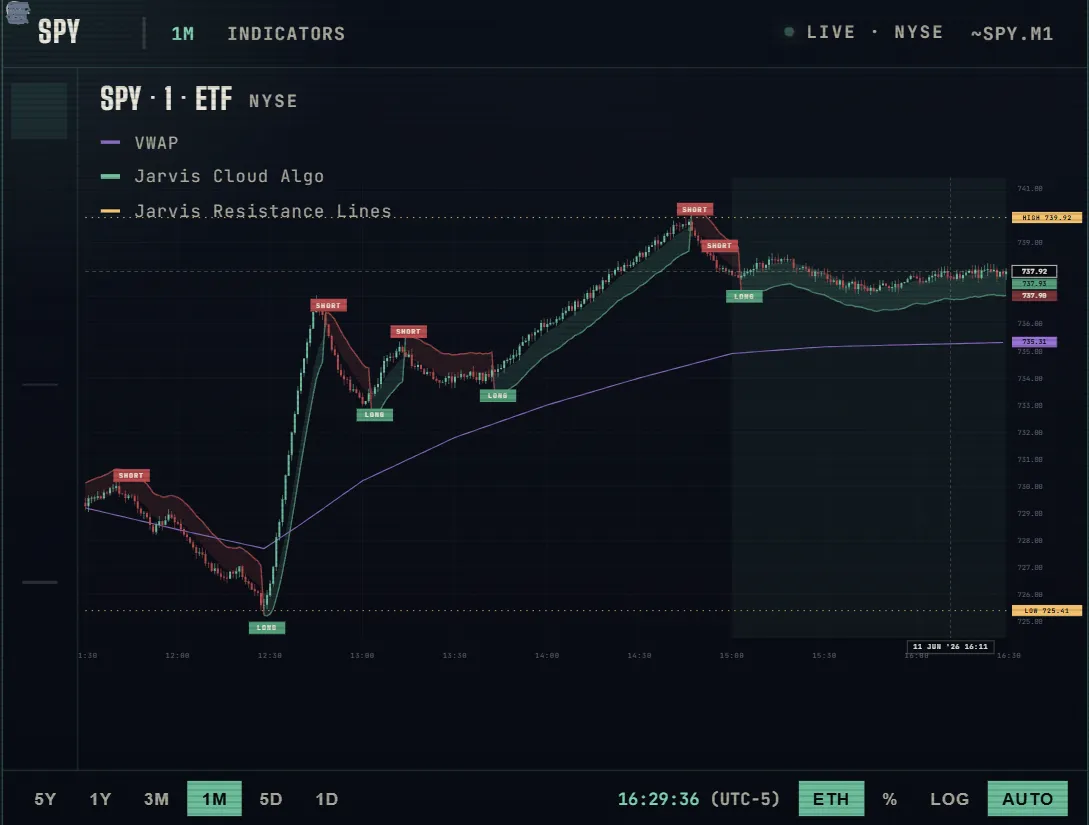
Take the pressure out of your trades. Jarvis real-time trading signals make entries simple.
GET 30 days for FREE

This Is What Trading Clarity Looks Like

Does it feel like your trading strategy is always this close to breaking through?
  • Entering the right trades with the wrong timing
  • Breaking your own rules with emotional trading
  • Strategies that work for them, not for you
  • Hours of multi-monitor anxiety
The answer isn’t more effort, it’s less complexity. Jarvis keeps trading simple.One screen. One tool. One signal.

See How Jarvis Works

Trading Doesn’t Have to Be Complicated

In 2026 you don’t need 30 years of trading experience to know when to trade. Pair Jarvis with your favorite brokerage and trade on signals you can trust.

  • Options - Out-trade the experts with daily live-stream guidance.
  • Stocks - Invest at the optimal moment for maximum returns.
  • Futures - Master the art of day, swing, position, & hedge trading.

Jarvis is an algorithmic signal software that tells you exactly when to enter and exit a trade — in real time.

By analyzing volume, volatility, momentum, and probability simultaneously, Jarvis generates a single clear signal — Long or Short — so you spend less time guessing and more time executing. It doesn't touch your brokerage, it doesn't execute trades, and it doesn't replace your judgment. It just tells you when the setup is right.

Go long. Go short.

No worries.

#FearNoTrade

join the revolution

Our traders are everyday people who are taking back the market from trading elites and hedge funds. Together with Jarvis, traders are proving that overcomplicated strategies are no longer the path to profitability. Are you ready for a change?

RANDY F.

"Trust the Jarvis software and join the livestream presentation - the coaching is incredible! "Rip" does a great job highlighting why the software is suggesting when to enter or exit a trade."

“Jarvis gives me exactly wanted I was looking for. A simple confirmation to enter and exit a trade for consistent profits.”

BRENAN k.

"Jarvis kept it very simple and easy to work with.The live stream on Discord and the coaching was very professional and well informative. They really do keep trading simple at is finest!

Pricing

Traders need tools that can prove their value. Try Jarvis FREE for 30 days and see the difference for yourself.

Jarvis PRO
$199/mo
$99/month for the first 6 months
claim YOUR 30 days FREE
Real-Time Trading Tags
Fully Customizable Chart Settings
Options, Futures, & Stock Investing Tickers
JarvisLIVE Access on Discord
Worldwide Trading Community
Daily Trade Training
Private Education Library
Financial News Monitoring
24/7 Customer Support

Your Trading Community Is Here

Our network of traders speak the same language and help each others master our mindset as we trade with the same powerful tools.

Learn more
  • Master Jarvis in just a few days
  • Kick back with day trading mods on daily live stream
  • Meet friends & mentors with a shared passion for trading

Knowledge Is Power

Smart traders make even smarter decisions using Jarvis. Here are some resources to guide you along your trading journey.

Apr 27, 2026

How to Stop Revenge Trading (Before It Stops You)

After a loss, the next trade is usually the one that gets people in trouble.

You start the day with a plan. You mark your high and low, wait for the setup, and take the trade. Then it goes wrong. Sharp reversal. Stop hit. You're down money and the market doesn't care.

What happens next is where most traders lose more than that first trade ever cost them.

What Revenge Trading Looks Like

Most traders think revenge trading looks like panic. It doesn't. It shows up as false confidence.

The next setup suddenly feels obvious. You're certain about it. But here's what's actually happening:

  • You jump back into the same ticker that just cost you money
  • You increase your position size, telling yourself you'll recover it in one trade
  • You skip your usual checks because they feel unnecessary in the moment
  • You call it conviction, but it isn't

That's revenge trading. And from the outside, it's easy to spot: faster entries than usual, ignoring your own rules, increasing your size to win back losses, and focusing on the ticker that hurt you instead of paying attention to the market.

Loss aversion makes traders feel losses twice as strongly as gains. As soon as a trade goes wrong, your brain is under emotional pressure it didn’t have before. The market stays the same, but your mindset shifts.

That's the psychology before the next trade even loads. Self-doubt sets in. Second-guessing replaces process. At that point, the market hasn't changed, but the trader has. That's when accounts start to bleed.


You'll Never Willpower Your Way Out

Traders set rules. They promise themselves it won't happen again. After the next loss, it often does.

Willpower runs out. Research in trading psychology shows that emotions like fear and greed don’t just influence decisions—they can take over. After a loss, your brain goes into recovery mode.

No amount of willpower or discipline can fix that in the moment.

A veteran trader in the Jarvis Discord — with over twenty years in the market — made an emotional entry last year. He broke his own rules. Caught himself mid-trade and got out.

When the community called it out, he agreed: it was a bad entry, and he knew it before he ever took it. The trade could have cost him $10,000 to $15,000.

Twenty years of experience. He still did it.

Knowing the rules and following them under pressure are two different things. Structure is what closes that gap. Not the willingness to do better, but a system that makes the decision before emotion gets involved.

Knowing what to do and actually doing it under pressure are two different things.

Most traders are in a stage where overconfidence and awareness haven't caught up to each other yet.

The gap isn't motivation. Traders at this stage have already proven they can make money.

What they haven't built is the structure that holds when emotion takes over.

That's what's missing.


How Jarvis Breaks the Cycle

On a Friday morning, by 9:50 AM, every trader in the session had made between 67% and 254% on a single trade. Discord shut down for the day. Go home. See you Monday.

Big win. Day's over. The day is done. The quickest way to lose a great morning is to keep trading after a win.

What willpower can't is remove the decisions that emotion corrupts. Not by managing how a trader feels, but by making the entry criteria objective.

Objectives don’t care about your feelings. FOMO lives in the gap between "I see a setup" and "I checked the criteria." Jarvis closes that gap.

Here are the three rules that put a stop to revenge trading:

Rule 1: The tag.

No Jarvis signal on the 1-minute chart, no trade. Full stop. A gut feeling isn't a tag. The need to recover isn't a tag. The signal fires or it doesn't. Nothing else qualifies as an entry.

Rule 2: The range.

Even if you get a tag, if the price isn’t within your set range, you don’t take the trade. This rule stops you from chasing.

If you want to jump in outside your range, the answer is always the same: you can’t take that trade. You’ll get hurt if you do. No exceptions.

Rule 3: The 1 Gate 3:

The 15-minute trend. This chart tells you which direction to trade. If everything is red, you only take puts. Don’t rely on your feelings—the 15-minute chart gives you the answer. Your job is to follow it.

Learn the Jarvis community names directly: riding bareback. That's when a loss hits on a tag and the next trade gets entered before the signal forms, driven by the need to get the money back.

This is revenge trading in its purest form. The only person getting revenge is the market.

Wait for the next tag. Every time. No exceptions.

Before every trade, ask yourself: Are you angry? Are you trying to get even? If yes, turn off your computer and come back tomorrow. The market will always offer another setup. Your job is to be ready when it does.


The Reset: No Signal, No Trade

One of the most experienced traders in the Jarvis community made 16 trades from January to April and only had one loss. It wasn’t because he never felt tempted to break the rules. It’s because the criteria don’t care about feelings—they either say yes or no.

Here's what trading with a signal-based system does: a loss doesn't change the rules. The trend, the range, and the tag are still required. All three, every time. Being down money is not a fourth input. It carries no weight in the equation.

The traders who stop revenge trading aren’t the ones who became tougher. They’re the ones who removed the option altogether.

No signal, no trade. That's not a mindset exercise. That's a rule. And it's the only rule that holds when everything else stops working.

Try a free 30-day trial and experience what it’s like to trade with structure.


The information provided is for educational purposes only and does not constitute financial or investment advice. All trading involves risk. Past performance is not indicative of future results.


Frequently Asked Questions

Q: What is revenge trading and why do traders do it?

Revenge trading happens when you stop trading because of a good setup and start trading just to win back money, get even with a ticker, or prove your last loss was a mistake.

It’s an emotional reaction after a loss, often marked by rushing, taking bigger positions, breaking your own rules, and focusing on recovery instead of your edge.

Traders do this because loss aversion is built into our brains—losses feel twice as painful as gains feel good. That imbalance puts pressure on your decisions as soon as a trade goes wrong. What seems like new confidence is really just panic in disguise.


Q: How do I stop revenge trading in real time?

Before your next trade, ask yourself two things: Are you angry? Are you just trying to get your money back? If you answer yes to either, close your screen and come back tomorrow. The market will always offer another setup, and your job is to be ready for it.

To stop revenge trading in real time, use criteria that emotions can’t override: a set range, a confirmed signal, and a trend that matches your direction. If any of these are missing, don’t trade—not because you’re being disciplined, but because your rules say no.


Q: How does Jarvis help prevent revenge trading?

Jarvis takes away the decisions that emotions can mess up by making entry criteria objective. For a valid trade, three things must happen: the 15-minute trend confirms the direction, the price is within the set range, and a Jarvis tag appears on the 1-minute chart.

If any of these are missing, you don’t trade. Losses, frustration, and the urge to recover don’t matter in this system. The signal either appears or it doesn’t. Jarvis also makes it clear when you’re riding bareback—jumping in before the next tag is a sure sign of revenge trading.

The system sticks to the rule, even if you don’t want to. No signal, no trade.

After a loss, the next trade is usually the one that gets people in trouble.

You start the day with a plan. You mark your high and low, wait for the setup, and take the trade. Then it goes wrong. Sharp reversal. Stop hit. You're down money and the market doesn't care.

What happens next is where most traders lose more than that first trade ever cost them.

What Revenge Trading Looks Like

Most traders think revenge trading looks like panic. It doesn't. It shows up as false confidence.

The next setup suddenly feels obvious. You're certain about it. But here's what's actually happening:

  • You jump back into the same ticker that just cost you money
  • You increase your position size, telling yourself you'll recover it in one trade
  • You skip your usual checks because they feel unnecessary in the moment
  • You call it conviction, but it isn't

That's revenge trading. And from the outside, it's easy to spot: faster entries than usual, ignoring your own rules, increasing your size to win back losses, and focusing on the ticker that hurt you instead of paying attention to the market.

Loss aversion makes traders feel losses twice as strongly as gains. As soon as a trade goes wrong, your brain is under emotional pressure it didn’t have before. The market stays the same, but your mindset shifts.

That's the psychology before the next trade even loads. Self-doubt sets in. Second-guessing replaces process. At that point, the market hasn't changed, but the trader has. That's when accounts start to bleed.


You'll Never Willpower Your Way Out

Traders set rules. They promise themselves it won't happen again. After the next loss, it often does.

Willpower runs out. Research in trading psychology shows that emotions like fear and greed don’t just influence decisions—they can take over. After a loss, your brain goes into recovery mode.

No amount of willpower or discipline can fix that in the moment.

A veteran trader in the Jarvis Discord — with over twenty years in the market — made an emotional entry last year. He broke his own rules. Caught himself mid-trade and got out.

When the community called it out, he agreed: it was a bad entry, and he knew it before he ever took it. The trade could have cost him $10,000 to $15,000.

Twenty years of experience. He still did it.

Knowing the rules and following them under pressure are two different things. Structure is what closes that gap. Not the willingness to do better, but a system that makes the decision before emotion gets involved.

Knowing what to do and actually doing it under pressure are two different things.

Most traders are in a stage where overconfidence and awareness haven't caught up to each other yet.

The gap isn't motivation. Traders at this stage have already proven they can make money.

What they haven't built is the structure that holds when emotion takes over.

That's what's missing.


How Jarvis Breaks the Cycle

On a Friday morning, by 9:50 AM, every trader in the session had made between 67% and 254% on a single trade. Discord shut down for the day. Go home. See you Monday.

Big win. Day's over. The day is done. The quickest way to lose a great morning is to keep trading after a win.

What willpower can't is remove the decisions that emotion corrupts. Not by managing how a trader feels, but by making the entry criteria objective.

Objectives don’t care about your feelings. FOMO lives in the gap between "I see a setup" and "I checked the criteria." Jarvis closes that gap.

Here are the three rules that put a stop to revenge trading:

Rule 1: The tag.

No Jarvis signal on the 1-minute chart, no trade. Full stop. A gut feeling isn't a tag. The need to recover isn't a tag. The signal fires or it doesn't. Nothing else qualifies as an entry.

Rule 2: The range.

Even if you get a tag, if the price isn’t within your set range, you don’t take the trade. This rule stops you from chasing.

If you want to jump in outside your range, the answer is always the same: you can’t take that trade. You’ll get hurt if you do. No exceptions.

Rule 3: The 1 Gate 3:

The 15-minute trend. This chart tells you which direction to trade. If everything is red, you only take puts. Don’t rely on your feelings—the 15-minute chart gives you the answer. Your job is to follow it.

Learn the Jarvis community names directly: riding bareback. That's when a loss hits on a tag and the next trade gets entered before the signal forms, driven by the need to get the money back.

This is revenge trading in its purest form. The only person getting revenge is the market.

Wait for the next tag. Every time. No exceptions.

Before every trade, ask yourself: Are you angry? Are you trying to get even? If yes, turn off your computer and come back tomorrow. The market will always offer another setup. Your job is to be ready when it does.


The Reset: No Signal, No Trade

One of the most experienced traders in the Jarvis community made 16 trades from January to April and only had one loss. It wasn’t because he never felt tempted to break the rules. It’s because the criteria don’t care about feelings—they either say yes or no.

Here's what trading with a signal-based system does: a loss doesn't change the rules. The trend, the range, and the tag are still required. All three, every time. Being down money is not a fourth input. It carries no weight in the equation.

The traders who stop revenge trading aren’t the ones who became tougher. They’re the ones who removed the option altogether.

No signal, no trade. That's not a mindset exercise. That's a rule. And it's the only rule that holds when everything else stops working.

Try a free 30-day trial and experience what it’s like to trade with structure.


The information provided is for educational purposes only and does not constitute financial or investment advice. All trading involves risk. Past performance is not indicative of future results.


Frequently Asked Questions

Q: What is revenge trading and why do traders do it?

Revenge trading happens when you stop trading because of a good setup and start trading just to win back money, get even with a ticker, or prove your last loss was a mistake.

It’s an emotional reaction after a loss, often marked by rushing, taking bigger positions, breaking your own rules, and focusing on recovery instead of your edge.

Traders do this because loss aversion is built into our brains—losses feel twice as painful as gains feel good. That imbalance puts pressure on your decisions as soon as a trade goes wrong. What seems like new confidence is really just panic in disguise.


Q: How do I stop revenge trading in real time?

Before your next trade, ask yourself two things: Are you angry? Are you just trying to get your money back? If you answer yes to either, close your screen and come back tomorrow. The market will always offer another setup, and your job is to be ready for it.

To stop revenge trading in real time, use criteria that emotions can’t override: a set range, a confirmed signal, and a trend that matches your direction. If any of these are missing, don’t trade—not because you’re being disciplined, but because your rules say no.


Q: How does Jarvis help prevent revenge trading?

Jarvis takes away the decisions that emotions can mess up by making entry criteria objective. For a valid trade, three things must happen: the 15-minute trend confirms the direction, the price is within the set range, and a Jarvis tag appears on the 1-minute chart.

If any of these are missing, you don’t trade. Losses, frustration, and the urge to recover don’t matter in this system. The signal either appears or it doesn’t. Jarvis also makes it clear when you’re riding bareback—jumping in before the next tag is a sure sign of revenge trading.

The system sticks to the rule, even if you don’t want to. No signal, no trade.

Educational Resources
Apr 9, 2026

Jarvis Isn't Just for Day Trading

If you've been using Jarvis for day trading, you already appreciate zero-lag signals that keep you in the split-second price action. But Jarvis gives you far more ways to trade.

By selecting the candle duration in the upper left of your dashboard, you'll notice that Jarvis tags adjust according to the timeframe, meaning tags depict opportunities ideal for varying instrument expirations.

Today, we look at how Jarvis adjusts signals to identify opportunities in day trading, swingtrading, and investing strategies.

Trade examples are hypothetical and applied retroactively to demonstrate the Jarvis strategy.

Trades were not executed in a live account. Results do not account for liquidity, slippage, or fees.

TRADE 1

Day Trade Options | Timeframe: 1M SPY Call | Mar 10 | 10:26 am – 11:06 am C680 $1.05 → $2.32 | 120% profit

Can you be patient for three minutes? This trade retraces minimally after the tag forms.Everything after that is the most textbook trade you'll ever see. No liquidity checks, just asmooth ride til you're well over 100% profit.

Remember: Tags are only formed, and actionable, once a candle closes. Don't enter prematurely or you might find yourself in on a trade where there's no signal on the screen.

TRADE 2

Swing Trade Options | Timeframe: 1H SPY Put | March 13 | Expiration: Sept 30P260930P668 $35.44 → $52.77 | 49% profit (active)

Swing traders watching 1-day charts have been speculating the next collapse, having seen twoproper market crashes since 2020 with setups similar to what we're seeing here.

On the day Jarvis marked this trade with a Long tag, a Sept 30 expiration options put could behad for $35.44 per contract. As of this writing (3/30/26) that same contract is $52.77. For traderswhose goal it is to ride a real market crash, Jarvis has us in with great timing. From here it'sabout your goals. Your existing profit is at risk if there's a reversal, but portfolios concernedabout a collapse may choose to hedge their investments by staying in this short.

This is NOT a recommendation to enter this put now — that train has left the station. We want todemonstrate how Jarvis identifies prime swing setups at major inflection points in the market.Don't wanna miss the next one? Join the daily conversation on JarvisLIVE on Discord!

TRADE 3

Common Stock Investing | Timeframe: 1H | S&P 500

For long-term investing, you want to buy when the market is bearish, but not til it's done falling.Setting a 1-Day timeframe turns Jarvis into a long-term trend finder. In other words, each tag issaying "that trend is done now." This becomes particularly advantageous for answering the coreinvestor question: When do I know to buy the dip?

Last year's crash took out 1/4 of SPY's valuation. Liquid investors would be looking for themoment to reinvest. Jarvis chose a safe reentry that yielded great returns just before May 2025.Only problem? Jarvis wasn't live then. But it is now.

As we ride out the rest of the current downturn, we're looking for that moment yet again. Thered/green cloud shift will come first, anticipating the ending of a trend. The next Long tag maybe the next great opportunity to buy into a market before the bull breaks loose.

The Lesson

Wealth Through Diversification

Smart traders aren't only trading — they're investing too. We built Jarvis to signal different typesof trading because diversifying into steady securities will empower you to fund the risk/reward(and fun) of speculative trading.

There's more coming this month about Jarvis' expanding trading suite, and we're excited toshare the news! Until then, join us on Discord any weekday — we'd love to trade with you!

It's a great day to trade.

[Try Jarvis free for 30 days]

Risk Disclosure: Trading stocks, options, futures, and cryptocurrencies involves substantial riskand is not suitable for every investor. An investor could potentially lose all or more than the initialinvestment. Risk capital is money that can be lost without jeopardizing one's financial security orlifestyle. Only risk capital should be used for trading. Past performance is not necessarilyindicative of future results.

CFTC Rules 4.41: Simulated performance results have inherent limitations. Unlike an actualperformance record, simulated results do not represent actual trading. Since trades have notbeen executed, results may have under- or over-compensated for the impact of certain marketfactors, such as a lack of liquidity. Simulated trading programs are generally designed with thebenefit of hindsight. No representation is being made that any account will or is likely to achieveprofits or losses similar to those shown.

Disclaimer: The information and trading signals provided by KTS Trading, LLC are foreducational and informational purposes only and do not constitute investment advice or an offeror solicitation to buy or sell any security. We do not execute trades, manage accounts, orguarantee results. All trading decisions are made solely by you at your own risk. You shouldconsult with a licensed financial advisor before making any investment decisions. KTS Trading,LLC is registered with the U.S. Securities and Exchange Commission.

If you've been using Jarvis for day trading, you already appreciate zero-lag signals that keep you in the split-second price action. But Jarvis gives you far more ways to trade.

By selecting the candle duration in the upper left of your dashboard, you'll notice that Jarvis tags adjust according to the timeframe, meaning tags depict opportunities ideal for varying instrument expirations.

Today, we look at how Jarvis adjusts signals to identify opportunities in day trading, swingtrading, and investing strategies.

Trade examples are hypothetical and applied retroactively to demonstrate the Jarvis strategy.

Trades were not executed in a live account. Results do not account for liquidity, slippage, or fees.

TRADE 1

Day Trade Options | Timeframe: 1M SPY Call | Mar 10 | 10:26 am – 11:06 am C680 $1.05 → $2.32 | 120% profit

Can you be patient for three minutes? This trade retraces minimally after the tag forms.Everything after that is the most textbook trade you'll ever see. No liquidity checks, just asmooth ride til you're well over 100% profit.

Remember: Tags are only formed, and actionable, once a candle closes. Don't enter prematurely or you might find yourself in on a trade where there's no signal on the screen.

TRADE 2

Swing Trade Options | Timeframe: 1H SPY Put | March 13 | Expiration: Sept 30P260930P668 $35.44 → $52.77 | 49% profit (active)

Swing traders watching 1-day charts have been speculating the next collapse, having seen twoproper market crashes since 2020 with setups similar to what we're seeing here.

On the day Jarvis marked this trade with a Long tag, a Sept 30 expiration options put could behad for $35.44 per contract. As of this writing (3/30/26) that same contract is $52.77. For traderswhose goal it is to ride a real market crash, Jarvis has us in with great timing. From here it'sabout your goals. Your existing profit is at risk if there's a reversal, but portfolios concernedabout a collapse may choose to hedge their investments by staying in this short.

This is NOT a recommendation to enter this put now — that train has left the station. We want todemonstrate how Jarvis identifies prime swing setups at major inflection points in the market.Don't wanna miss the next one? Join the daily conversation on JarvisLIVE on Discord!

TRADE 3

Common Stock Investing | Timeframe: 1H | S&P 500

For long-term investing, you want to buy when the market is bearish, but not til it's done falling.Setting a 1-Day timeframe turns Jarvis into a long-term trend finder. In other words, each tag issaying "that trend is done now." This becomes particularly advantageous for answering the coreinvestor question: When do I know to buy the dip?

Last year's crash took out 1/4 of SPY's valuation. Liquid investors would be looking for themoment to reinvest. Jarvis chose a safe reentry that yielded great returns just before May 2025.Only problem? Jarvis wasn't live then. But it is now.

As we ride out the rest of the current downturn, we're looking for that moment yet again. Thered/green cloud shift will come first, anticipating the ending of a trend. The next Long tag maybe the next great opportunity to buy into a market before the bull breaks loose.

The Lesson

Wealth Through Diversification

Smart traders aren't only trading — they're investing too. We built Jarvis to signal different typesof trading because diversifying into steady securities will empower you to fund the risk/reward(and fun) of speculative trading.

There's more coming this month about Jarvis' expanding trading suite, and we're excited toshare the news! Until then, join us on Discord any weekday — we'd love to trade with you!

It's a great day to trade.

[Try Jarvis free for 30 days]

Risk Disclosure: Trading stocks, options, futures, and cryptocurrencies involves substantial riskand is not suitable for every investor. An investor could potentially lose all or more than the initialinvestment. Risk capital is money that can be lost without jeopardizing one's financial security orlifestyle. Only risk capital should be used for trading. Past performance is not necessarilyindicative of future results.

CFTC Rules 4.41: Simulated performance results have inherent limitations. Unlike an actualperformance record, simulated results do not represent actual trading. Since trades have notbeen executed, results may have under- or over-compensated for the impact of certain marketfactors, such as a lack of liquidity. Simulated trading programs are generally designed with thebenefit of hindsight. No representation is being made that any account will or is likely to achieveprofits or losses similar to those shown.

Disclaimer: The information and trading signals provided by KTS Trading, LLC are foreducational and informational purposes only and do not constitute investment advice or an offeror solicitation to buy or sell any security. We do not execute trades, manage accounts, orguarantee results. All trading decisions are made solely by you at your own risk. You shouldconsult with a licensed financial advisor before making any investment decisions. KTS Trading,LLC is registered with the U.S. Securities and Exchange Commission.

Community Highlights
Mar 25, 2026

Crypto Just Landed on Jarvis. Here's Why That Changes Everything.

You've been trading crypto the hard way.

Watching five charts at once at 2 AM. Chasing the pump. Panic-selling the dip. Refreshing Twitter to see if some anonymous account with a laser-eye profile picture knows something you don't.

And every time you swear you'll be more disciplined next time — until the next candle moves and you're right back in the chaos.

Here's the thing: it's not your fault. Crypto has always been a market without guardrails. No closing bell. No circuit breakers. No structure. Just 24 hours of noise dressed up as opportunity, with your emotions invited to every single session.

That ends today.

Jarvis now supports crypto trading.

Why Crypto Traders Are the Most Emotionally Exposed Traders Alive

Options traders deal with time decay. Stock traders deal with earnings surprises. Crypto traders deal with all of it — plus a market that never closes, moves that happen while you're asleep, and a culture that rewards the loudest voice, not the most disciplined one.

The psychological warfare is non-stop.

You see Bitcoin climb 8% overnight and feel like you missed it. So you buy in at the top of the move. It retraces. You hold because you "believe in it." It drops another 12%. Now you're not trading anymore — you're coping.

Or you catch a real move. A clean 200% run on an altcoin. And instead of taking profit, you let greed whisper that this one's going to 500%. Then 1000%. Then it halves in four hours and you're back to flat.

Sound familiar?

This is the enemy inside every crypto trade. And it's the same enemy Jarvis was built to defeat.

What Jarvis Actually Does to a Crypto Chart

Jarvis doesn't add noise. It removes it.

Under the hood, Jarvis synthesizes the indicators that serious traders use — momentum signals, volume patterns, trend confirmation — and distills everything down to one thing on your screen: a signal telling you when to enter, and when to get out.

No Discord calls to verify. No influencer to follow. No gut feeling to second-guess.

You'll see a Long tag form. You enter. You'll see the signal break. You exit.

That's it. That's the whole game.

The traders who consistently profit aren't the ones with the most screens or the most conviction. They're the ones who follow a repeatable process and let it do its job — trade after trade, without interference.

Jarvis gives crypto traders that process for the first time.

The 24/7 Market Problem — Finally Solved

Here's what makes crypto uniquely brutal: the market never closes. Which means your temptation never closes either.

3 AM move? You're awake for it. Weekend pump? You're watching. Sunday night crash? You're in it.

Traditional traders get a break. They go home. The market closes. The psychological pressure resets. Crypto traders don't get that. And without a structured signal telling them when to actually act, they're always one sleepless trade away from a bad decision.

Jarvis changes the relationship you have with the clock. Instead of watching every candle waiting for something to happen, you wait for a signal. And when there's no signal, there's no trade. You close the screen. You live your life.

That is not a limitation. That is the strategy.

If You've Never Heard of Jarvis, Here's What You Need to Know

Jarvis was built by two traders who spent decades doing it the hard way — developing the intuition, logging the losses, building the process through years of trial and expensive error.

Then they asked a different question: What if you didn't have to?

What took them decades, Jarvis compresses into a single screen with clear signals. Options traders who found Jarvis reported understanding the system within a week of watching the live stream. Not months. Not years. A week.

The same system is now live for crypto.

If you've been trading crypto on instinct — or worse, on someone else's instinct — you now have something better. A proven signal framework built for the exact chaos that crypto throws at you.

The Market Doesn't Care About Your Conviction

This is the hardest truth in crypto, and almost nobody says it.

Your belief in a project doesn't protect your trade. Your research doesn't guarantee a return. The whitepaper you read, the community you trust, the influencer you follow — none of it moves the chart in your favor.

What moves the chart is price action. And what protects your account is the discipline to follow a signal instead of a story.

Crypto has always been a market that rewards storytelling. Jarvis is a tool built for traders, not believers. And for the first time, crypto traders can trade it that way.

Execute Clean. Take Profit. Be Content.

The same three-part equation that works in options works in crypto.

Execute Clean — Wait for the signal. Don't enter on a hunch, a feeling, or a fear of missing out. If there's no tag, there's no trade.

Take Profit — Exit when Jarvis tells you to exit. Not when you've calculated a bigger number in your head. Not after you've convinced yourself the move has more room. When the signal breaks, you step out.

Be Content — A 60% winner that you actually captured is worth more than a 400% winner you watched reverse in your account. The discipline to take what the market gives you — consistently, without interference — is what builds accounts over time.

Crypto traders have never had a system designed to protect them from themselves. Now they do.

This Is Your On-Ramp

If you've been grinding crypto charts without a signal framework, you already know what it costs. The missed exits. The emotional holds. The "I should have known" moments at 3 AM.

You don't have to know. You couldn't have known. But now you have something that does.

Jarvis is free for your first 30 days. Come watch the live stream, see the signals form in real time, and find out what it feels like to trade with structure in a market that has never offered any.

[Start your free 30-day trial →]

The crypto market is open right now. The question is: are you trading it, or is it trading you?

Trade examples are hypothetical and applied retroactively to demonstrate the Jarvis strategy. Trades were not executed in a live account. Results are based on exact signal execution and do not account for liquidity, slippage, or fees.

Frequently Asked Questions

Does Jarvis work for crypto the same way it works for stocks and options?

Yes. The same signal framework — Long/Short tags triggered by real-time indicator synthesis — now applies to crypto markets. You follow the tag, you exit when the signal breaks, and you stay out when there's no signal to follow.

Can I use Jarvis for crypto if I've never traded stocks or options?

Absolutely. Jarvis was built to eliminate the learning curve, not extend it. Crypto traders who come to Jarvis without any background in traditional trading can learn the system within a week of live-stream participation. You're not learning indicators — you're learning to follow a signal.

Crypto runs 24/7. How does Jarvis handle that?

Jarvis gives you structure inside the chaos. Instead of watching every candle and reacting to every move, you wait for a signal. No signal, no trade. This protects you from the biggest risk in 24/7 markets: the temptation to always be doing something.

What's the biggest mistake crypto traders make that Jarvis helps prevent?

Emotional overrides. Entering without a signal. Holding through a reversal because you "believe" in the move. These are the decisions that vaporize accounts. Jarvis takes the decision-making away from your emotions and gives it back to a system.

Is crypto on Jarvis available with the free trial?

Yes. Your first 30 days are free. That includes crypto signals, the live stream, and the full Jarvis interface — everything you need to see whether this changes the way you trade.


The information and trading signals provided on this site are for educational and informational purposes only and do not constitute financial, investment, or trading advice. Past performance is not indicative of future results. All trading involves substantial risk of loss.

You've been trading crypto the hard way.

Watching five charts at once at 2 AM. Chasing the pump. Panic-selling the dip. Refreshing Twitter to see if some anonymous account with a laser-eye profile picture knows something you don't.

And every time you swear you'll be more disciplined next time — until the next candle moves and you're right back in the chaos.

Here's the thing: it's not your fault. Crypto has always been a market without guardrails. No closing bell. No circuit breakers. No structure. Just 24 hours of noise dressed up as opportunity, with your emotions invited to every single session.

That ends today.

Jarvis now supports crypto trading.

Why Crypto Traders Are the Most Emotionally Exposed Traders Alive

Options traders deal with time decay. Stock traders deal with earnings surprises. Crypto traders deal with all of it — plus a market that never closes, moves that happen while you're asleep, and a culture that rewards the loudest voice, not the most disciplined one.

The psychological warfare is non-stop.

You see Bitcoin climb 8% overnight and feel like you missed it. So you buy in at the top of the move. It retraces. You hold because you "believe in it." It drops another 12%. Now you're not trading anymore — you're coping.

Or you catch a real move. A clean 200% run on an altcoin. And instead of taking profit, you let greed whisper that this one's going to 500%. Then 1000%. Then it halves in four hours and you're back to flat.

Sound familiar?

This is the enemy inside every crypto trade. And it's the same enemy Jarvis was built to defeat.

What Jarvis Actually Does to a Crypto Chart

Jarvis doesn't add noise. It removes it.

Under the hood, Jarvis synthesizes the indicators that serious traders use — momentum signals, volume patterns, trend confirmation — and distills everything down to one thing on your screen: a signal telling you when to enter, and when to get out.

No Discord calls to verify. No influencer to follow. No gut feeling to second-guess.

You'll see a Long tag form. You enter. You'll see the signal break. You exit.

That's it. That's the whole game.

The traders who consistently profit aren't the ones with the most screens or the most conviction. They're the ones who follow a repeatable process and let it do its job — trade after trade, without interference.

Jarvis gives crypto traders that process for the first time.

The 24/7 Market Problem — Finally Solved

Here's what makes crypto uniquely brutal: the market never closes. Which means your temptation never closes either.

3 AM move? You're awake for it. Weekend pump? You're watching. Sunday night crash? You're in it.

Traditional traders get a break. They go home. The market closes. The psychological pressure resets. Crypto traders don't get that. And without a structured signal telling them when to actually act, they're always one sleepless trade away from a bad decision.

Jarvis changes the relationship you have with the clock. Instead of watching every candle waiting for something to happen, you wait for a signal. And when there's no signal, there's no trade. You close the screen. You live your life.

That is not a limitation. That is the strategy.

If You've Never Heard of Jarvis, Here's What You Need to Know

Jarvis was built by two traders who spent decades doing it the hard way — developing the intuition, logging the losses, building the process through years of trial and expensive error.

Then they asked a different question: What if you didn't have to?

What took them decades, Jarvis compresses into a single screen with clear signals. Options traders who found Jarvis reported understanding the system within a week of watching the live stream. Not months. Not years. A week.

The same system is now live for crypto.

If you've been trading crypto on instinct — or worse, on someone else's instinct — you now have something better. A proven signal framework built for the exact chaos that crypto throws at you.

The Market Doesn't Care About Your Conviction

This is the hardest truth in crypto, and almost nobody says it.

Your belief in a project doesn't protect your trade. Your research doesn't guarantee a return. The whitepaper you read, the community you trust, the influencer you follow — none of it moves the chart in your favor.

What moves the chart is price action. And what protects your account is the discipline to follow a signal instead of a story.

Crypto has always been a market that rewards storytelling. Jarvis is a tool built for traders, not believers. And for the first time, crypto traders can trade it that way.

Execute Clean. Take Profit. Be Content.

The same three-part equation that works in options works in crypto.

Execute Clean — Wait for the signal. Don't enter on a hunch, a feeling, or a fear of missing out. If there's no tag, there's no trade.

Take Profit — Exit when Jarvis tells you to exit. Not when you've calculated a bigger number in your head. Not after you've convinced yourself the move has more room. When the signal breaks, you step out.

Be Content — A 60% winner that you actually captured is worth more than a 400% winner you watched reverse in your account. The discipline to take what the market gives you — consistently, without interference — is what builds accounts over time.

Crypto traders have never had a system designed to protect them from themselves. Now they do.

This Is Your On-Ramp

If you've been grinding crypto charts without a signal framework, you already know what it costs. The missed exits. The emotional holds. The "I should have known" moments at 3 AM.

You don't have to know. You couldn't have known. But now you have something that does.

Jarvis is free for your first 30 days. Come watch the live stream, see the signals form in real time, and find out what it feels like to trade with structure in a market that has never offered any.

[Start your free 30-day trial →]

The crypto market is open right now. The question is: are you trading it, or is it trading you?

Trade examples are hypothetical and applied retroactively to demonstrate the Jarvis strategy. Trades were not executed in a live account. Results are based on exact signal execution and do not account for liquidity, slippage, or fees.

Frequently Asked Questions

Does Jarvis work for crypto the same way it works for stocks and options?

Yes. The same signal framework — Long/Short tags triggered by real-time indicator synthesis — now applies to crypto markets. You follow the tag, you exit when the signal breaks, and you stay out when there's no signal to follow.

Can I use Jarvis for crypto if I've never traded stocks or options?

Absolutely. Jarvis was built to eliminate the learning curve, not extend it. Crypto traders who come to Jarvis without any background in traditional trading can learn the system within a week of live-stream participation. You're not learning indicators — you're learning to follow a signal.

Crypto runs 24/7. How does Jarvis handle that?

Jarvis gives you structure inside the chaos. Instead of watching every candle and reacting to every move, you wait for a signal. No signal, no trade. This protects you from the biggest risk in 24/7 markets: the temptation to always be doing something.

What's the biggest mistake crypto traders make that Jarvis helps prevent?

Emotional overrides. Entering without a signal. Holding through a reversal because you "believe" in the move. These are the decisions that vaporize accounts. Jarvis takes the decision-making away from your emotions and gives it back to a system.

Is crypto on Jarvis available with the free trial?

Yes. Your first 30 days are free. That includes crypto signals, the live stream, and the full Jarvis interface — everything you need to see whether this changes the way you trade.


The information and trading signals provided on this site are for educational and informational purposes only and do not constitute financial, investment, or trading advice. Past performance is not indicative of future results. All trading involves substantial risk of loss.

Jarvis Features and Tips

What Do You Want Out of Trading?

A whole world of would-be traders out there want access to the lifestyle trading can unlock.

Now, with Jarvis, trading is all yours.

Jarvis beats the system

That is custom-made to box out retail traders. We’ve democratized trading with the best digital tools so anyone can have a seat at the table.

Complexity has no place

In today’s trading landscape. Though some will love the art of doing it all by hand, Jarvis delivers elite results for traders who simply trust the software.

The trading lifestyle

Has never been more accessible. Our dream is to see Jarvis triple the number of full-time traders making an incredible income from their living room.

See Jarvis in Action Today

Get full access to Jarvis free for 30 days and see how real-time algo signals change the way you trade.